PERSPECTIVE: Airports are catalysts: Sydney’s future faces west, and so does its new airport
David Holm, COX Principal, on how Sydney’s second airport became Western Sydney’s first, as Western Sydney International (Nancy-Bird Walton) Airport prepares to open.
Over a decade ago, I spoke at an aviation conference in Paris about a project that didn’t exist yet: Sydney’s second airport. At the time, there had been no formal announcement or design brief, only the usual political musing about when and where. Sydney had been debating a second airport since the 1960s, and I wanted to understand what one might mean for the city.
After the talk, my friend Cristiano Ceccato from ZHA came up and suggested we bid for it together. I told him there was nothing to bid for.
Four years after, COX Architecture and ZHA won the international design competition, chosen from 49 bidders around the world. Later this month, the first passenger flights will leave Western Sydney International (Nancy-Bird Walton) Airport.
Somewhere between Paris and that win, we stopped calling it Sydney’s second airport and started calling it Western Sydney’s first. This was an important change that gave a growing region an airport of its own, and a new city something to build its identity around.
Sydney’s population has passed five million and continues to grow. Geographically contained by the Hawkesbury to the north, the Blue Mountains to the west and the Royal National Park to the south, the city had one direction left to grow, and for decades that has been west. The need for more transport including a new airport became imperative.
My research for the Paris talk looked at how other world cities grew from one airport to several, and two things stood out. A new airport rarely competes head-on with an established one. London’s airports each have their own personality and serve different travellers, a distinction that grew over decades. The second: each new airport was a catalyst that drew roads, rail and jobs towards it, helping a city spread its weight more evenly.
That’s the shift Sydney is making now, as a city planned around three centres: the Harbour City, the River City of Parramatta, and the Western Parkland City, now growing around this airport.
This is significant for people in Penrith, Liverpool and Campbelltown, who will now have an international gateway on their side of the city, open 24 hours. It means shorter trips to see family overseas and more jobs closer to home. For many visitors, the front door to Sydney will now open onto Western Sydney first.
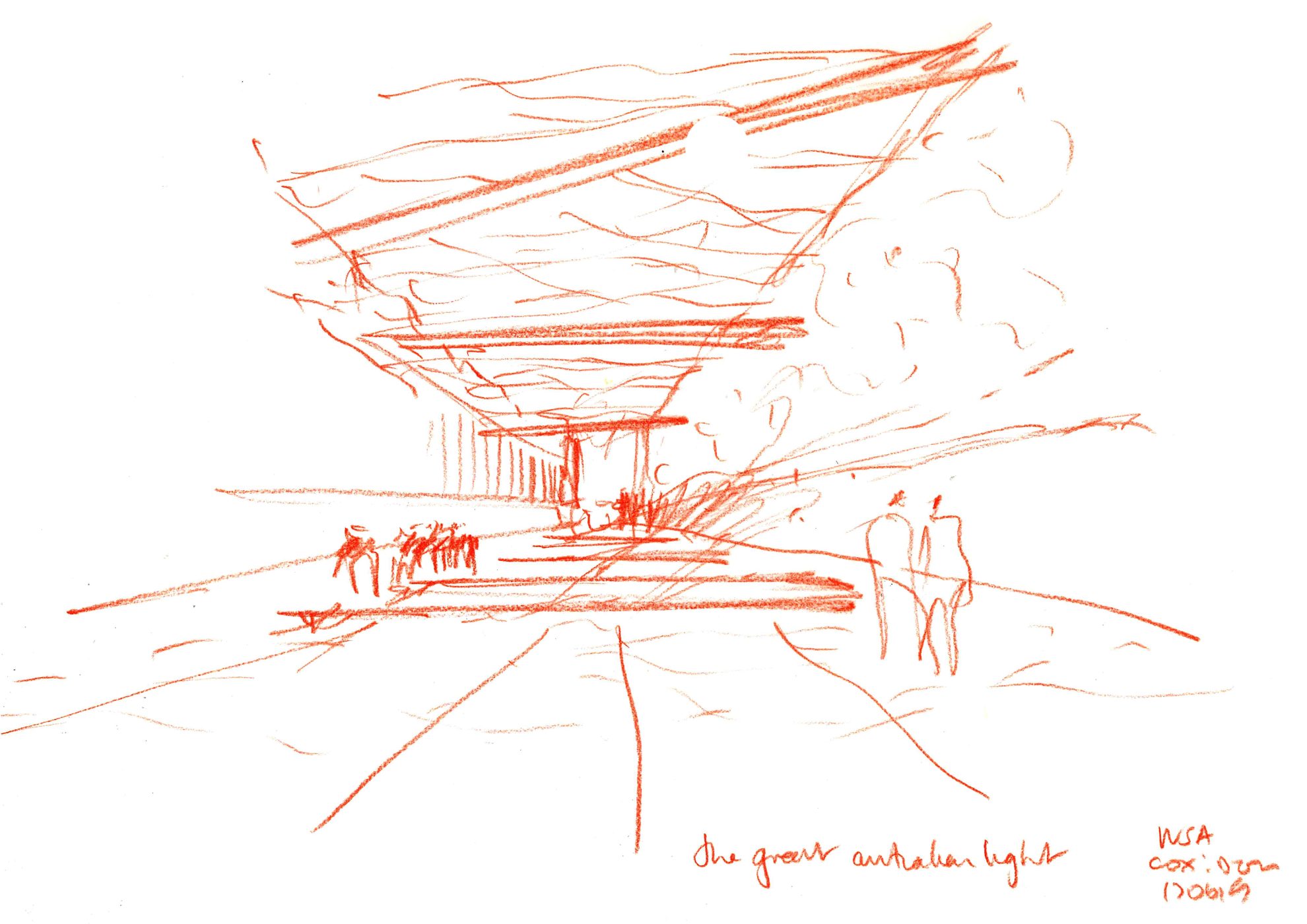
That raised a question we took seriously from the first sketch. If this is the first thing people see, what should it tell them about where they’ve landed?
What followed was the development of a design that balanced the pragmatic and the poetic.
Pragmatically, an airport is a hard-working machine. One building handles international and domestic passengers in both directions, border control, baggage, shops and gate lounges. Making that experience feel calm and simple took extensive work between our studios in Sydney and London.
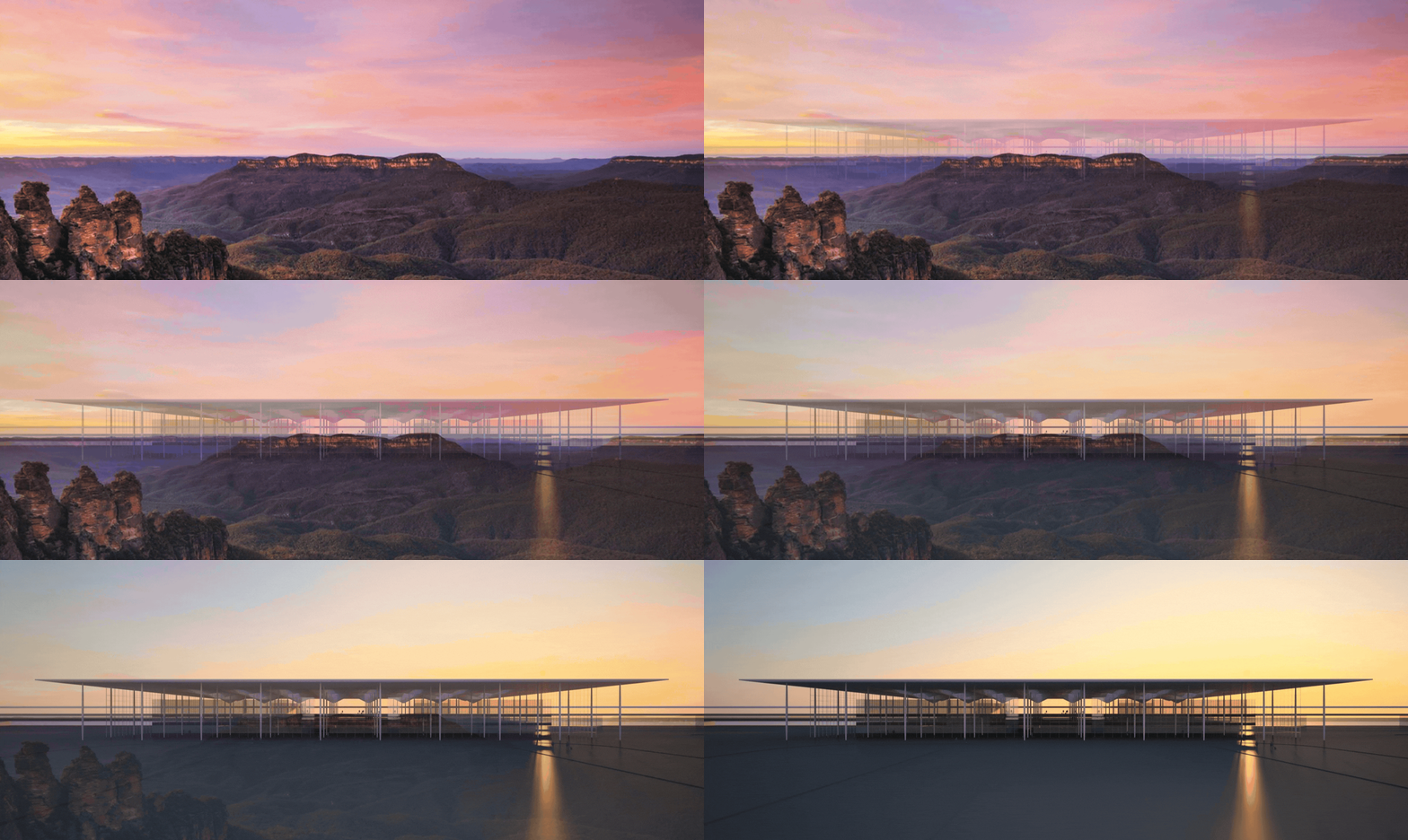
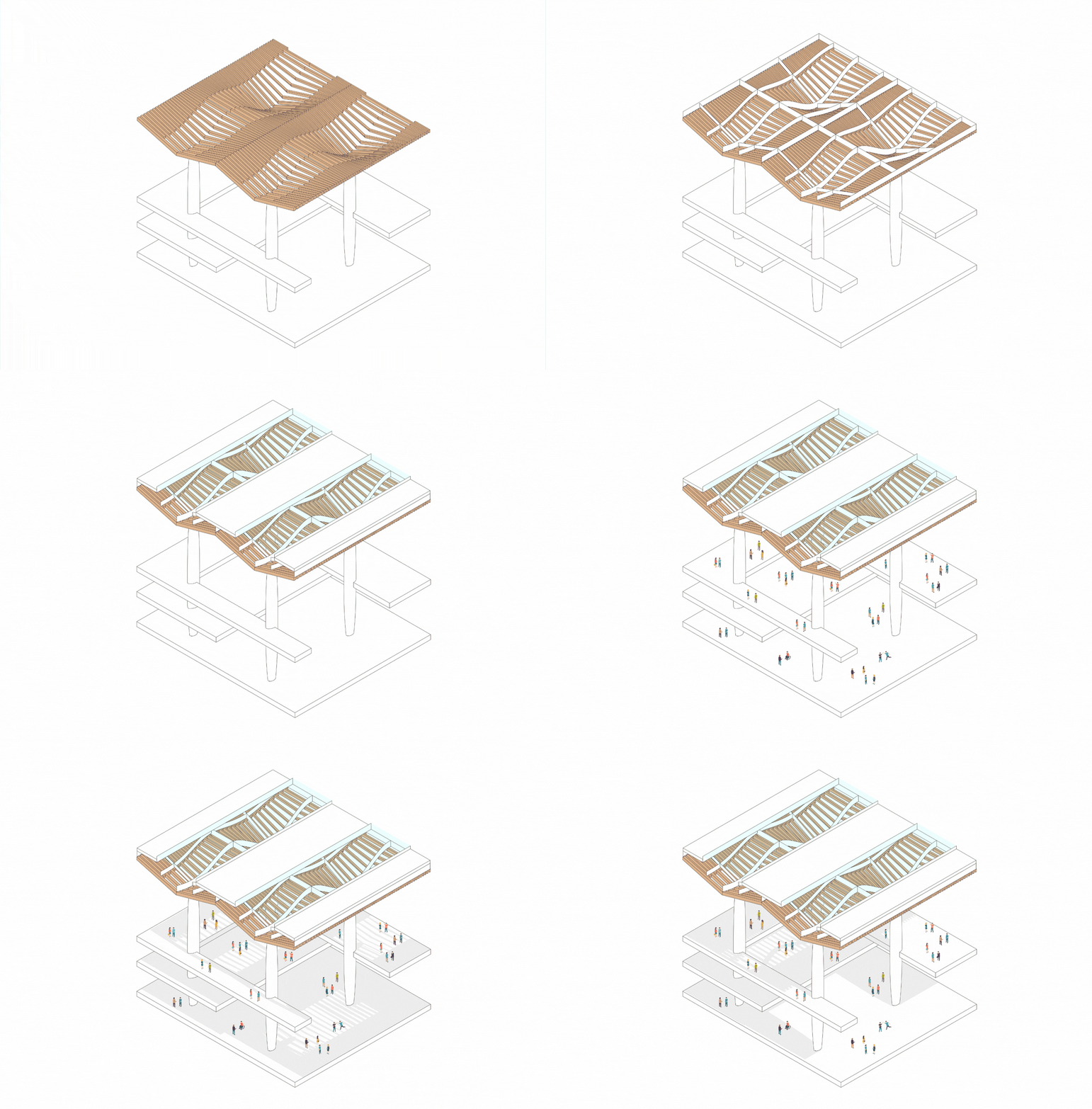
The poetic idea comes from place, and we set out to design an airport that could only ever be in this place. It sits on Dharug Country, on the Cumberland Plain, under a big sky with the Blue Mountains on the horizon. The terminal is low and long, like the land around it. Its warm sculptural ceiling filters daylight the way a eucalypt canopy does. You arrive under a veranda, that most Australian of thresholds, a shaded place between outside and in. The palette of materials reflects what it is to be in Western Sydney: sandstones, timbers and earthy colours inside take their cue from the region, and the Australian light does much of the wayfinding.
We worked with Murawin and Dharug Custodians to make sure the stories of this Country informed the design from the start. Western Sydney is also one of the most culturally diverse parts of Australia, and we wanted the terminal to feel open to everyone who comes through it, whether they are flying out for the first time or coming home after twenty years away.
When our design was complete, Multiplex was appointed to build it, with Woods Bagot as Lead Design and Delivery Architect as part of Multiplex’s design and construction team. Construction finished in mid-2025, and the terminal that opens this month remains true to the design COX and ZHA conceived. Thousands of people have played a part in getting it here.
Many people will use the airport simply to get from one place to another. Good airport design should be close to invisible when you’re running late for a flight. I hope some will notice something more poetic: a place with a rich history and an exciting future, where the romance of travel is set within a backdrop of a region still developing its cultural narrative.
When Cristiano asked his question in Paris, there was nothing to bid for. Eleven years on, an airport named for Nancy-Bird Walton, one of our pioneering aviators, is about to open its doors. For our teams, it has been a long piece of work, and a personal one. We set out to design an airport that could stand among the best in the world, while reflecting a distinctly Australian architecture: a public landmark we hope will become an emblem of Western Sydney, and of Australia.
Attribution: COX Architecture and ZHA are the Competition, Concept and Reference Design Architects for Western Sydney International Airport. Woods Bagot is the Design and Delivery Lead as part of Multiplex’s construction team.