Reclaiming the ‘Spaghetti Junction’: A Provocation for Auckland’s Future
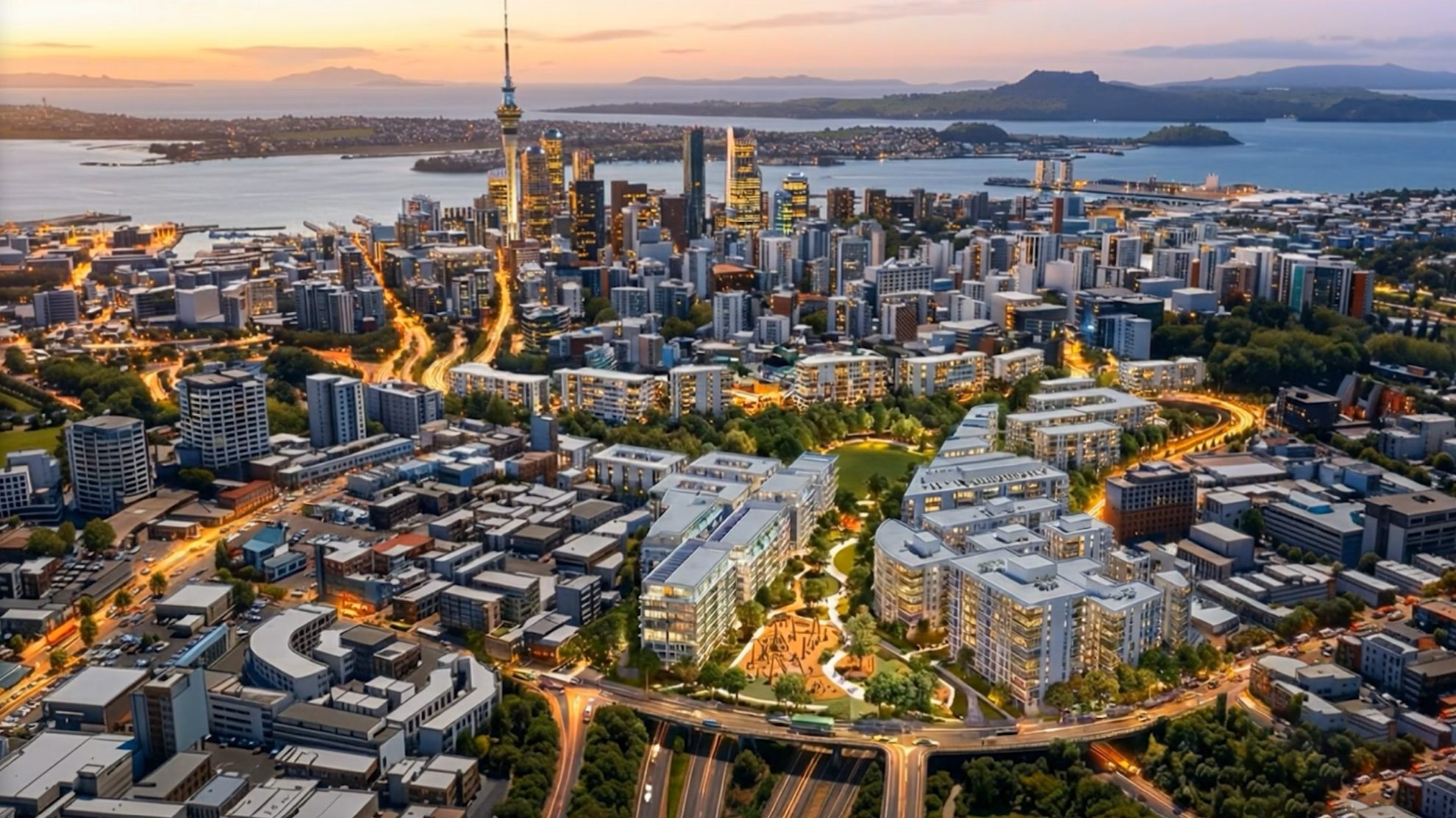
What if one of Auckland’s largest pieces of infrastructure could become one of its most connected public places, and a catalyst for new ways of living in the city?
Presented during this year’s NZ Design Week, COX’s Newton Green is a provocation exploring how the space above Auckland’s Central Motorway Junction (CMJ), affectionately known as the ‘Spaghetti Junction’, could be transformed into a new urban precinct combining public open space, housing and improved connectivity.
With Auckland projected to require around 400,000 additional homes by 2041, and only 2 percent of residents currently living in the city centre, the concept examines how this underutilised central infrastructure could contribute to housing supply while expanding public realm and improving movement across the city.
While the idea of building over motorway corridors is not new, the opportunity – and urgency – for Auckland is different today. Cities globally are re‑evaluating how infrastructure can be repurposed to support density, climate resilience and public life. Newton Green reframes this long‑standing conversation through the lens of Tāmaki Makaurau’s current challenges and future ambitions.
“Auckland continues to grapple with questions around density, growth and connectivity,” says Chris Millman, Director at COX Architecture. “Often the conversation becomes ‘we want density, just not in my backyard’. This provocation asks whether infrastructure corridors like the CMJ could become part of the solution – places where density is not only possible, but beneficial.”
Occupying approximately 17 hectares at the edge of the CBD, the CMJ is one of the city’s most strategically located yet physically divisive pieces of infrastructure. Designed almost exclusively for vehicles, it creates a significant barrier between surrounding neighbourhoods and the city centre.
For COX, the provocation is ultimately about reimagining a single‑use transport corridor as a civic landscape – one that prioritises people, culture and ecology.
[Above: Animation of Newton Green concept – a design provocation exploring how a new superstructure above Auckland’s Central Motorway Junction could support parkland, public connections and modular housing]
Rather than removing the motorway, Newton Green proposes a superstructure built above the existing network, allowing the infrastructure below to remain operational while creating a new layer of city above. The concept explores how disconnected parts of Auckland could be stitched back together through new walking and cycling connections, public parkland and mixed‑use development.
What interests us is how we can turn what is currently a ‘Valley of Vehicles’ into something that contributes to the public realm and reconnects the urban fabric,” says Millman. “If you can knit the city back together over the top of this infrastructure, you unlock the possibility for significant new green space and a place designed for people, not just traffic.”
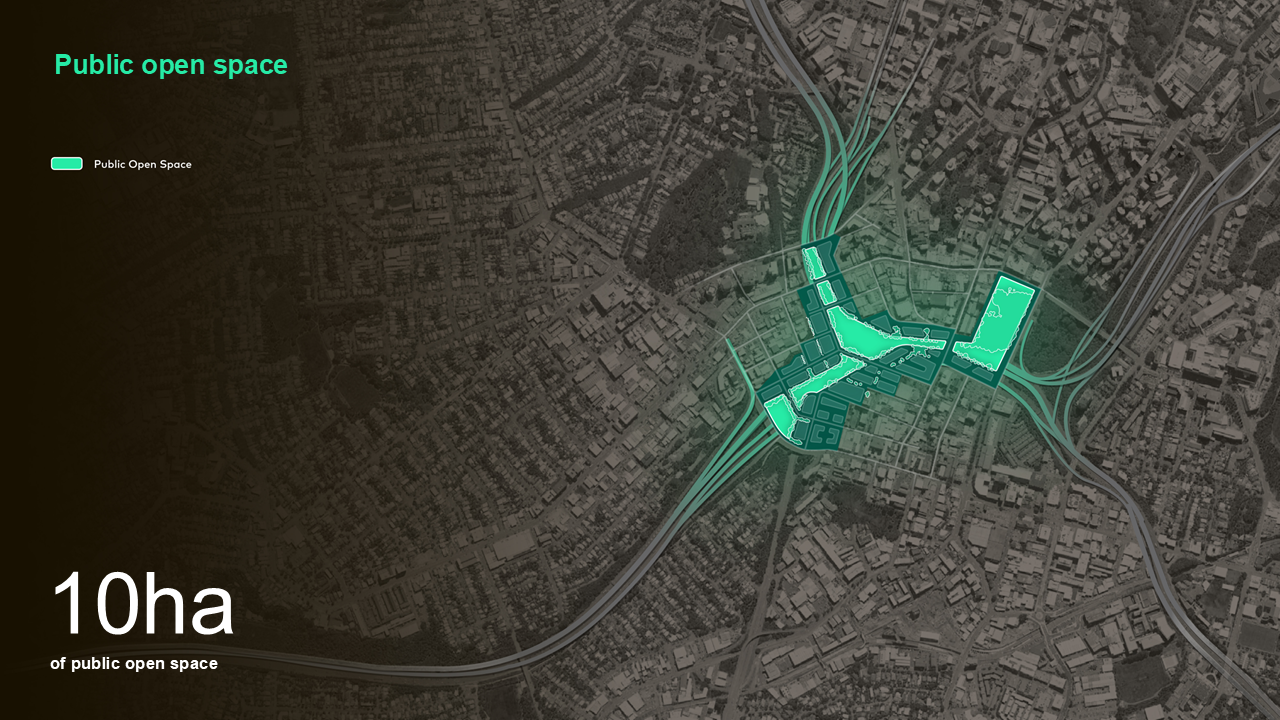
Initial studies suggest the concept could unlock approximately 10 hectares of new public open space alongside significant residential and mixed‑use opportunities, subject to further testing and delivery pathways. The framework has been deemed feasible in principle by Mott MacDonald, with further work to refine structural systems, staging and delivery in collaboration with key agencies.
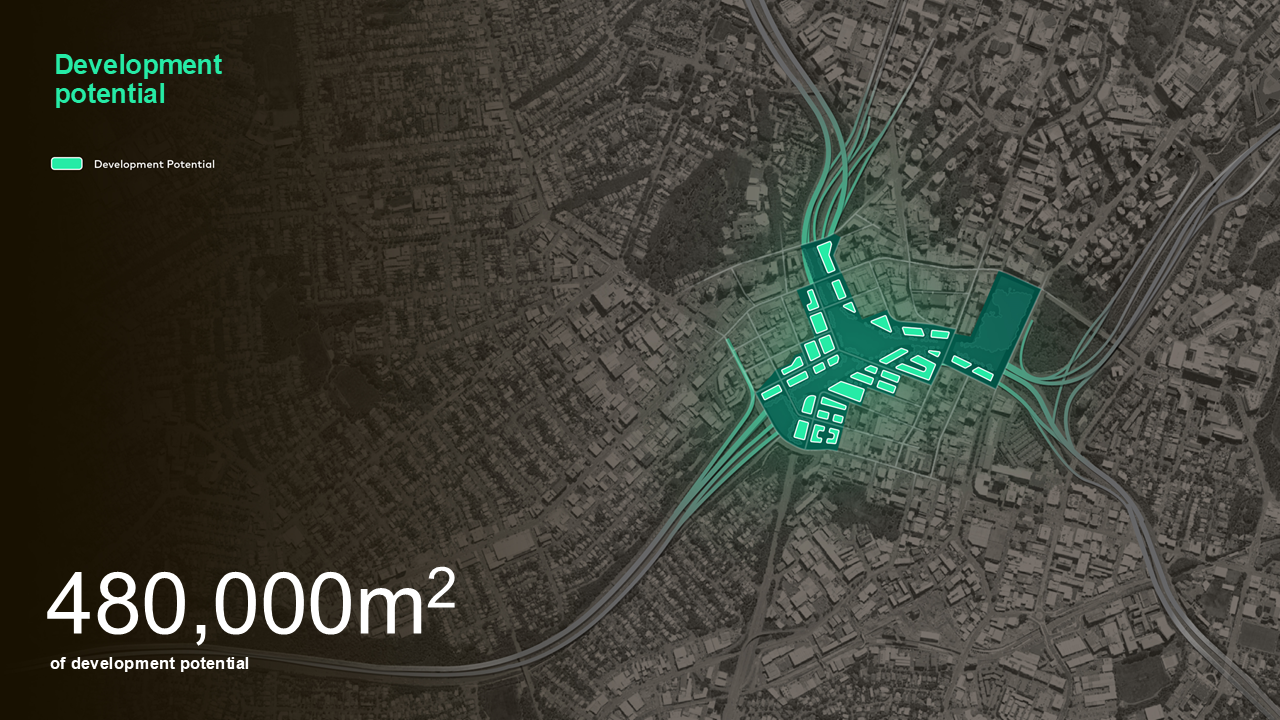
Importantly, the proposal recognises that large civic projects need to be economically viable as well as socially valuable. Integrating housing and mixed‑use development is therefore not just an add‑on, it is essential to enabling the public realm outcomes and supporting greater density in a highly connected part of the city.
COX also acknowledged Mana Whenua as kaitiaki of Tāmaki Makaurau, noting that any future development would be shaped through genuine partnership and engagement.
Modular Construction as an Enabler
Lightweight modular construction is a critical enabler of the concept, helping to make a superstructure above the motorway structurally and economically feasible.
“Modular construction is significantly lighter than traditional construction, which means you can potentially achieve greater density on a structure like this,” says Felipe Miranda, Director at COX Architecture. “Instead of four to six storeys, lightweight modular systems could allow for eight to twelve storeys or more, depending on the structural solution.”
Beyond structural efficiency, modular delivery could accelerate project timeframes and reduce disruption by allowing onsite works and offsite manufacturing to occur simultaneously.
“For us, modular isn’t just about speed,” says Miranda. “It’s about quality, safety and expanding what housing can look like. There’s still a misconception that modular means compromised design outcomes, but when done well, it can deliver sophisticated architectural and urban results at scale.”
COX has been actively exploring this approach through various residential projects, including Walker Street and Princess Street, which demonstrate how modular delivery can be applied to achieve both efficiency and design quality.
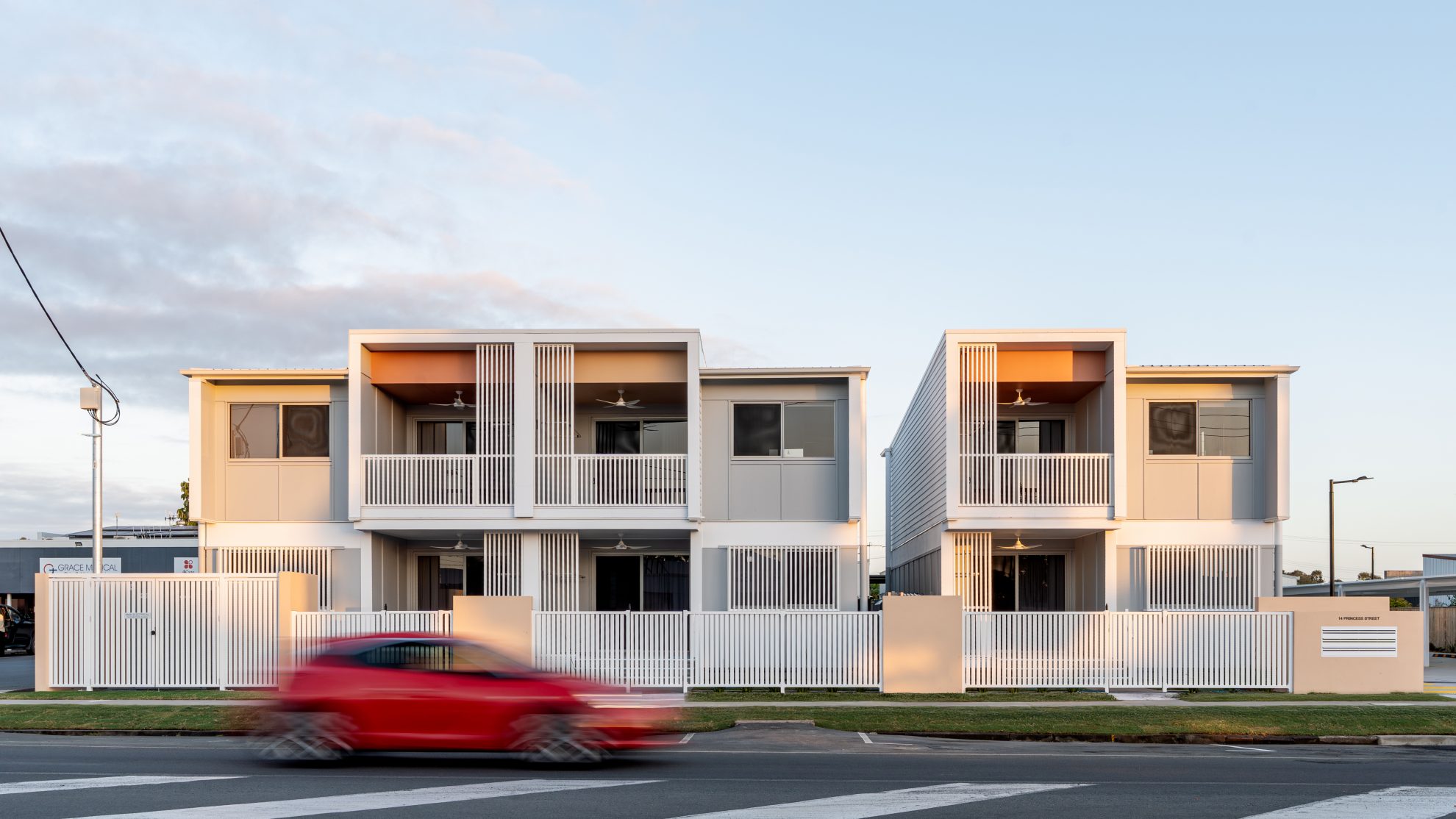
[Above: Low-rise modular housing developments in Princess Street, Bundaberg]
Learning from Global Precedents
While still conceptual, Newton Green draws from international precedents where cities have repurposed motorway corridors to reconnect urban fabric and improve public life. Projects such as Madrid Río in Madrid and the High Line in New York demonstrate how infrastructure once seen as divisive can become valuable civic assets.
For Auckland, the provocation is not a blueprint – it is an invitation. Any future iteration would require collaboration across government, industry, mana whenua and the community, alongside detailed testing of structural systems, planning and delivery models.
Ultimately, Newton Green asks a broader question relevant to cities well beyond Auckland: as urban populations grow, how might we rethink infrastructure corridors not as barriers, but as opportunities to reconnect the city?
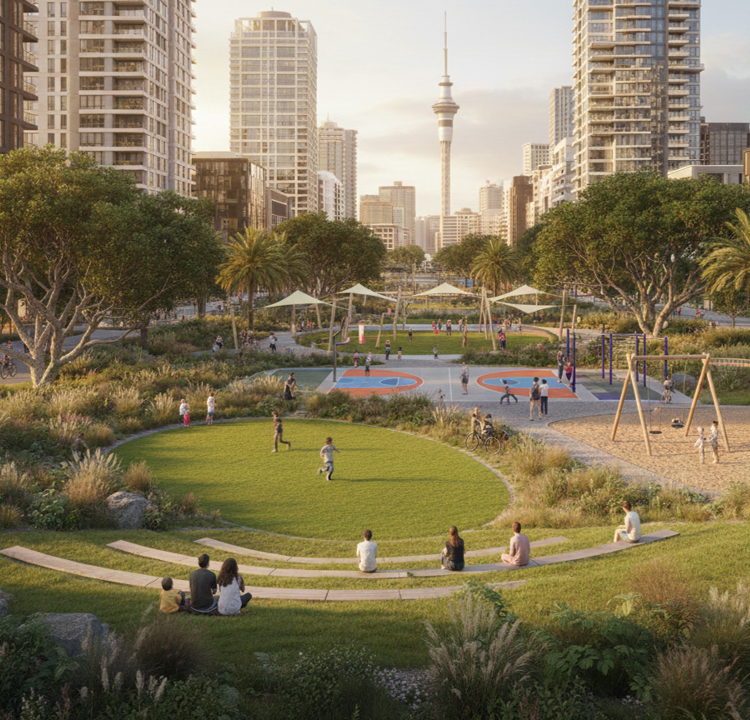
[Above: Newton Green – Concept vision of new public realm above the Spaghetti Junction]