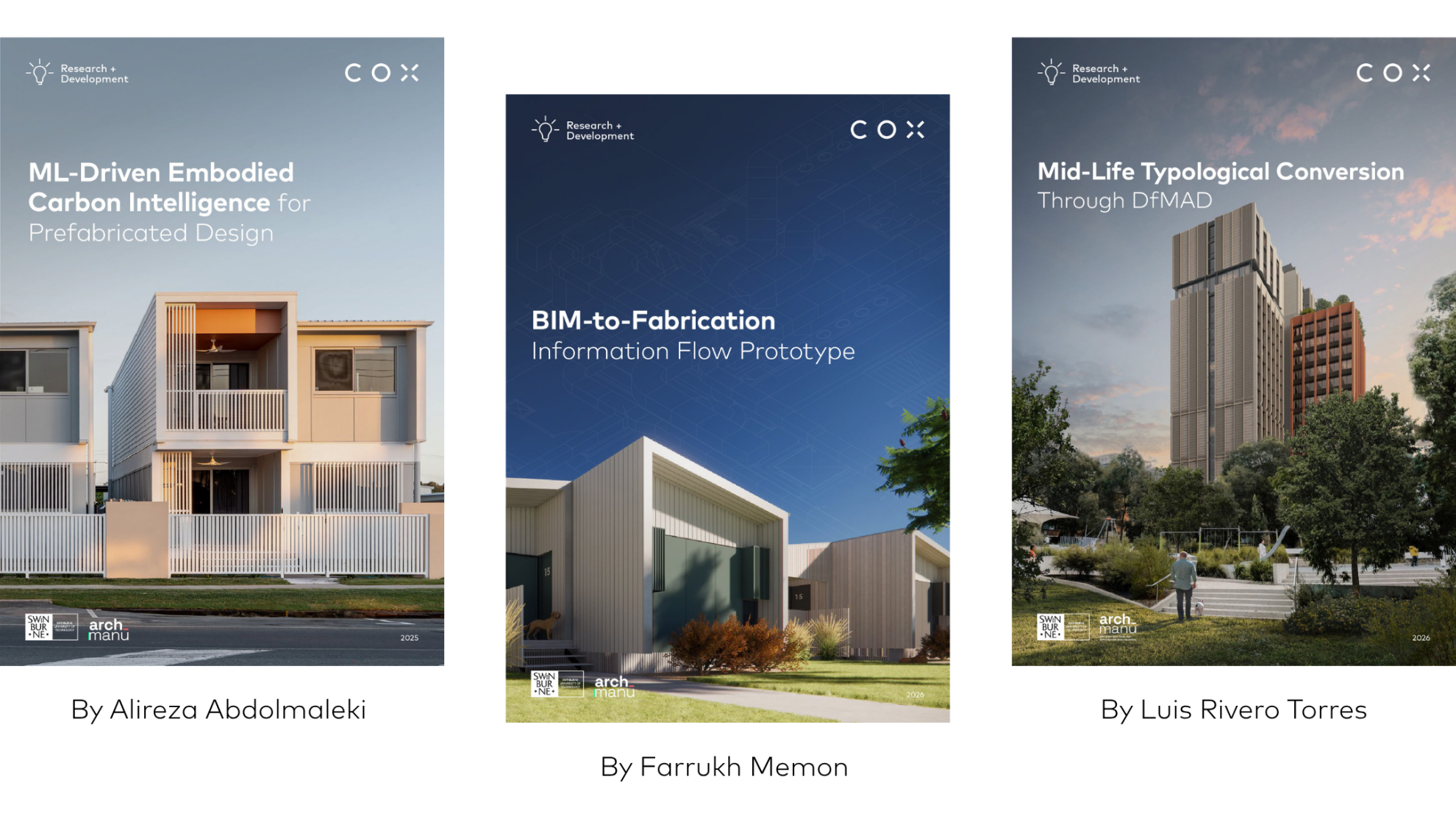
PERSPECTIVE: Solving prefabrication’s blind spots: Inside our research partnership with Arch_Manu
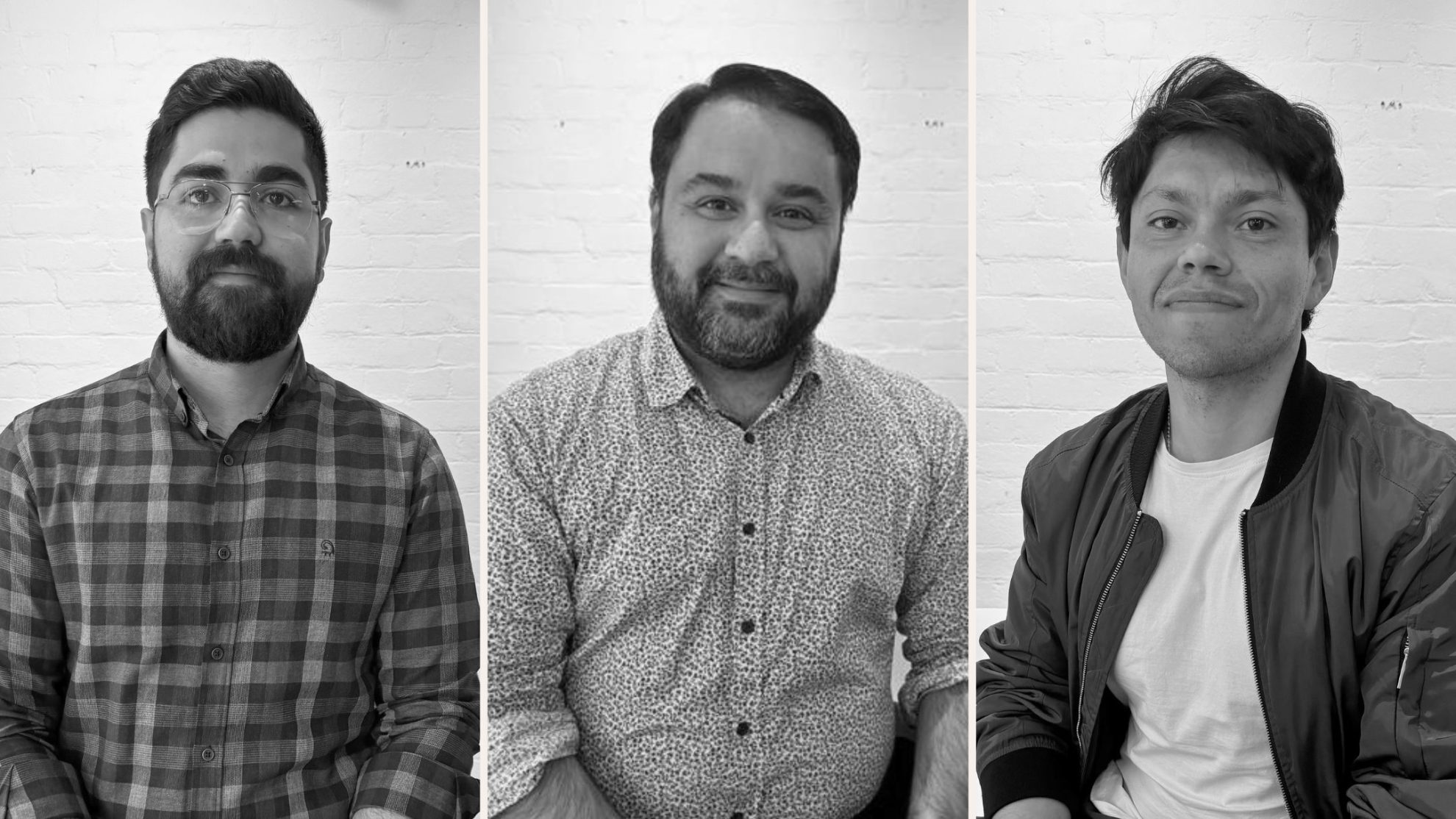
[Above left to right: Alireza Abdolmaleki, Farrukh Memon & Luis Rivero Torres]
Head of Research, Jacqueline Baker, on how 3 PhD students helped solve some of the biggest industry challenges around prefabrication approaches.
Prefabrication and modular construction are central to how the Architecture, Engineering, and Construction (AEC) industry will meet pressure on cost and carbon. But three problems keep holding the approach back: prefab strategies get locked in early, yet carbon assessment tools are too slow to keep pace with design; construction information is duplicated rather than shared between designers and manufacturers; and modular retrofit remains constrained by an industry built around “take, make, use and dispose.”
Over the past year, we have been working with three PhD students from Arch_Manu, the ARC Centre for Next-Gen Architectural Manufacturing, to solve these problems. The students spent a 3-month internship period in our Melbourne studio, working directly with our research, sustainability, design technology and project teams.
The carbon problem: prefab decisions get made without carbon data
Can machine learning support carbon-reducing prefab strategies early in the design?
Embodied carbon is largely determined at concept design, the stage where a project has the least information and the most uncertainty. By the time a team has enough detail to model carbon accurately, the prefabrication decisions that matter most have usually already been made.
Alireza Abdolmaleki, a computational designer and civil engineer, developed a web-based platform that uses machine learning trained on past projects, to surface carbon impacts as design decisions are made. This helps architects to assess prefabrication strategies for carbon at the point they’re chosen, avoiding surprises down the track.
The handover problem: information gets rebuilt, not shared
What if fabrication-ready information never had to be rebuilt?
Prefabricated construction depends on close coordination between designer and manufacturer, but the two rarely work from the same information. Documentation that’s fabrication-ready on the design side is routinely reinterpreted and rebuilt to meet manufacturing requirements, adding time and creating room for error.
Farrukh Memon, an architect and BIM technologist, developed a prototype system to carry documentation through that handover intact, so information stays traceable from design to fabrication instead of being remade at each step. This is designed to mean fewer manual reworks and fewer chances for mistakes to enter the process.
The conversion problem: buildings outlive their systems
What if a building could change use, efficiently, quickly and sustainably?
Mid- and high-rise office buildings are rarely built with future change of use in mind. When market changes occur, they are expensive and time consuming to convert to new uses. Sustainable strategies are needed, yet there are many challenges to overcome.
Luis Rivero Torres, an architect specialising in computational design and digital fabrication, developed an approach that keeps a building’s structure in place while its shorter-life parts – façades, interiors, plumbing – are swapped out using modular systems. This helps architects turn single-use buildings into ones that can adapt over time.
Where to from here?
Through recent co-living projects such as Herring Road, COX has become a leader in volumetric modular construction in Australia. In parallel, our research and development program focusses on solving some of the biggest challenges around prefabrication solutions, ensuring we continue to innovate in this space.
This work sits within a five-year partnership between COX and Arch_Manu – hosted at the University of New South Wales, with Swinburne University of Technology and the Adelaide University as partners – which is accelerating digital transformation across the AEC industry.
The AEC sector contributes more than AU$134 billion a year to the Australian economy but remains one of the country’s most resource-and carbon-intensive, and one of the slowest to adopt digital tools.
Arch_Manu brings together 25 PhD candidates and three postdoctoral fellows working with industry partners, including COX, on exactly these problems.
For COX, what matters is what this research changes on the ground. If carbon modelling can run earlier, documentation can survive the handover to the fabricator without being duplicated, and challenges are overcome around modular retrofit, those changes shift how a project gets designed from the first sketch, well before construction starts.